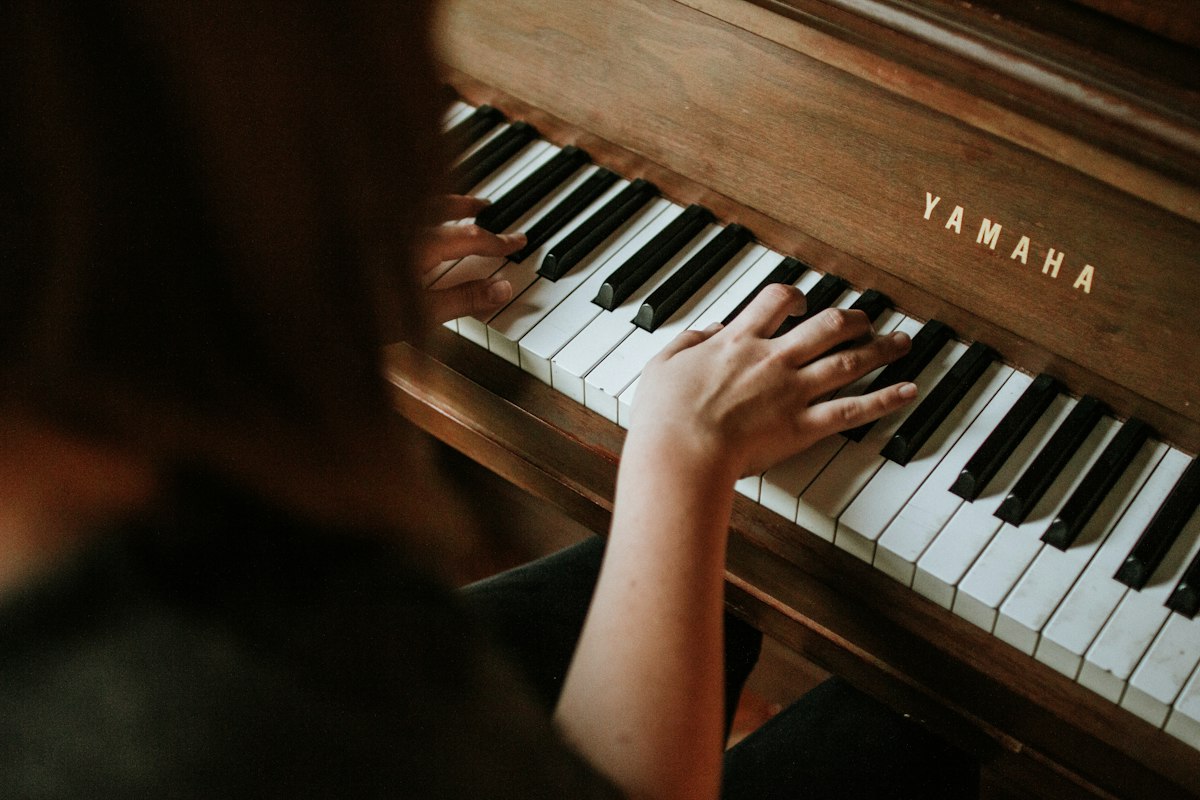
The Worship Keyboardist’s Journey
When you walk into church and see the keyboardist flowing freely across the keys, filling the sanctuary with palpable anointing and leading the congregation, it is entirely natural to wonder: “Could I ever do that? It looks so difficult!”
The good news is that learning keyboard for Christian ministry does not demand traditional conservatory methods or decades of classical sheet music study. In church, we utilize the popular functional method, focusing on chords, lead sheets, rhythmic perception, and spiritual sensitivity.
In this comprehensive guide, we map out the exact roadmap for you to advance from absolute scratch to playing your first song in service.
1. The Secret Key Map (Demystifying the Instrument)
Faced with 61, 76, or 88 black and white keys, beginners easily feel overwhelmed. However, the keyboard is incredibly logical. The entire instrument is constructed from repeating patterns of just 12 notes (7 white and 5 black).
How to Find Any Note With Closed Eyes
Look closely at the black keys. They always group together in repeating patterns of two and three:
[2 Black] [3 Black] [2 Black] [3 Black]- The Note C: Always located immediately to the left of the two black key cluster. Found the two black keys? The white key to their left is C!
- The Note F: Always located immediately to the left of the three black key cluster.
The 7 Natural Notes & Alphabet Symbols
In modern contemporary music, we do not write “Do, Re, Mi” on chord charts. We utilize the alphabet chord symbol system (letters A through G):
| Musical Note | Standard Symbol | Quick Navigation Tip |
|---|---|---|
| A (La) | A | First letter of the alphabet. |
| B (Si) | B | Second note starting from A. |
| C (Do) | C | White key to the left of two black keys. |
| D (Re) | D | White key nestled between two black keys. |
| E (Mi) | E | White key to the right of two black keys. |
| F (Fa) | F | White key to the left of three black keys. |
| G (Sol) | G | White key nestled among three black keys. |
2. Proper Posture & The “Curved Hand” Secret
Before pressing your first chord, pay close attention to ergonomics. Playing with rigid wrists or flat fingers causes tendon fatigue and prevents speed.
- Curved Fingers: Imagine holding a tennis ball or an apple in the palm of your hand. Your finger pads (the fleshy fingertips) should contact the keys, rather than striking with flat fingers or fingernails.
- Finger Numbering: In piano technique, we number our fingers 1 through 5 for both hands:
- Finger 1: Thumb
- Finger 2: Index
- Finger 3: Middle
- Finger 4: Ring
- Finger 5: Pinky (Little finger)
3. Your Very First Chord: The Major Triad
Everything in congregational music revolves around chords. A chord is a combination of three or more notes played simultaneously. The most fundamental and powerful type is the Triad (constructed from the Root, Third, and Fifth intervals).
Let us build a C Major (C) triad with your right hand:
- Position Finger 1 (Thumb) on note C.
- Position Finger 3 (Middle) on note E.
- Position Finger 5 (Pinky) on note G.
Depress all three keys at the exact same time. Feel the stability and harmonic clarity. Congratulations, you have just played the foundation of Western music!
4. The Role of the Left Hand (Church Bass)
While your right hand holds the triad, your left hand fulfills a vital role in church audio: playing the bass.
In the beginning, you do not need fast left-hand arpeggios. Simply strike the fundamental root note with Finger 5 (pinky) in the lower bass register (roughly two octaves below your right hand).
- When the chart calls for
C: Your right hand plays (C - E - G) while your left hand strikes a single low C. - When the chart calls for
G: Your right hand plays (G - B - D) while your left hand strikes a single low G.
5. Daily Practice Routine for Rapid Results
To progress without frustration, the secret is not practicing five hours on Saturday, but maintaining consistent, focused daily sessions. We recommend this simple 20-minute daily circuit:
- 5 Minutes Posture & Warm-up: Loosen your wrists and shoulders before sitting at your bench.
- 5 Minutes Blind Navigation: Close your eyes, touch the keys, and locate all C and F notes entirely by feeling the black key clusters.
- 10 Minutes Chord Transitions: Pick two chords (e.g. C and G) and practice transitioning between them in a slow 4-beat rhythm (1, 2, 3, 4 - switch - 1, 2, 3, 4).
Accelerate Your Entry Into the Worship Team
Attempting to learn keyboard alone through random internet videos often generates poor posture habits and knowledge gaps that stall your progress. Following a structured step-by-step curriculum built specifically for church ministry allows you to accomplish in months what would otherwise take years of trial and error.
At Worship in Every Note, we developed the definitive training academy for Christian musicians. From absolute beginner foundations to advanced stage arrangements, you gain access to validated practice schedules, hand-independence drills, and direct mentoring to turn your musical calling into reality. Step up to your place at the altar!